
How to Choose the Best Washing Machine for Your Home

We get through a lot of laundry in the UK. According to a government study, the average household puts a wash on four times a week, while homes with kids use them up to seven times. With your washing machine working that hard, it’s worth finding one that fits your home, your routine and your budget.
That’s where our home electricals team comes in. They’ve helped us put together this washing machine buying guide to help take the guesswork out of choosing your next appliance.
We know that choosing a laundry machine can be confusing. There are lots of brands out there, and every device seems to come with a long list of specs about weights, spin cycles, energy efficiency and beyond. Our washing machine guide will make it easier to work out which one you need and what’s important for you.
Three types of washing machine
When choosing a new washing machine, the first step is deciding which type is right for your home. There are three main types to choose from, each with its own benefits.
Freestanding washing machines
This is the most common type - it’s a single unit with a variety of washing settings. With a freestanding machine, you get the widest range of sizes, styles and colours available.
They’re a good option if:
• You don’t mind the machine being on display in your kitchen
• You have a cupboard or laundry room with a standpipe
Built-in or ‘integrated’ washing machines
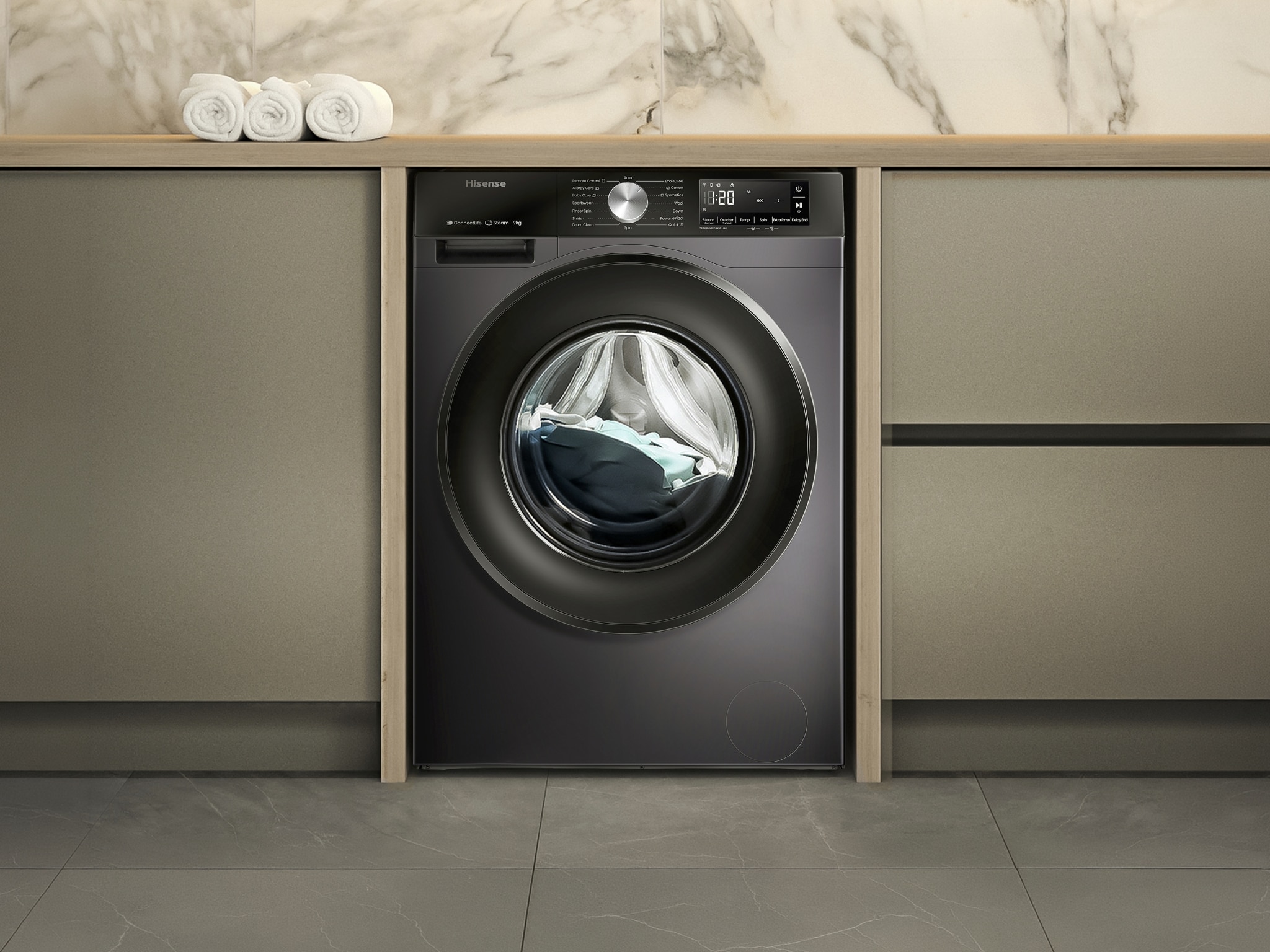
Built-in washing machines are designed to fit behind an attached kitchen cupboard door. This helps create a more seamless look in your kitchen, without a washing machine visible.
They’re a good option if:
• You’re having a new fitted kitchen built
• You already have a built-in washing machine and want to replace it with something new that will go in the space
Washer-dryers
If you don’t own a separate tumble dryer or don’t have space, then a washer dryer is a great option. They have a drying setting built in which can dry your clothes (for a certain time or to a chosen level of dryness).
They’re a good option if:
• You don’t have space for a tumble dryer and want to dry clothes fast
• You find that you often need to dry clothes indoors


Understand the measurements of a washing machine
When you’re choosing a washing machine, it’s really important to check how much space you have available (unless it’ll be going in a basement or laundry room, where space is less of an issue). There are few things more annoying than buying a new piece of equipment, then discovering it doesn’t fit into the space you have.
In the UK, standard washing machine dimensions are as follows (give or take a couple of centimetres):
● 85cm tall
● 60cm wide
● 60cm deep
Grab a tape measure and note down how deep, wide and tall the space is. When buying online, you can filter machines by size - to save you looking at washers that are either too big or small for your space.
A couple of additional pointers:
● Space behind: You’ll want an absolute minimum of 5cm space behind the washing machine to accommodate wires, the waste hose and water supply. More space is ideal.
● Dials and buttons: The depth of a washing machine (front to back) only includes the body of the washer itself, not the dials or controls that might stick out the front. Bear this in mind if you want something that sits flush with surrounding cupboards or the worktop above.
● Fitting in the space: You’ll need to make sure there’s enough wiggle room on either side and above to comfortably slide it into the space. Say the space available is 60cm wide and 85cm tall. Your washing machine width and height should be a bit smaller - at most 58cm wide and 83cm tall (and that would be pretty tight).
Washing machine drum capacity
Washing machine drum capacity can range from 7kg up to 13kg. The higher the capacity, the more you can fit in with each wash.
The table below will give you a rough idea of how much each drum capacity could wash on a standard cycle. Take note that some cycles (such as a delicate wash) might have much lower recommended capacity.
What size drum capacity should you go for?
Generally speaking, drum capacity is usually influenced by how many people live in the home:
-
A smaller drum capacity will make more sense for a couple or someone living alone.
-
A standard capacity drum would be suitable for families with one or two kids.
-
A **large drum capacity **is often the best washing machine for a large family of 3 or more kids.
But it also depends on what you’re washing and how often.
For example, a large family of two adults and four children might be fine with a standard 9kg drum capacity if they do two washing machine loads a day. For example, all the kids’ white school tops in one wash, then all colours in a second wash. A bigger capacity wouldn’t actually be necessary, since the drum wouldn’t get filled for these different washes.
Similarly, a couple who have outdoor jobs which mean their clothes get dirty, will want to wash a lot of items often. In this case, they might actually benefit from having a larger capacity washing machine.
Washing Machine Spin Speed
On any description of a washing machine, you’ll notice the spin speed is mentioned in rotations per minute (RPM). This tells you the maximum number of times a washing machine drum can rotate in one minute.
When a washing machine spins at a high RPM, it draws more water out of the fabrics inside. That means they won't be as damp when you take them out and will therefore dry faster.
A high RPM can be a good thing if you often wash certain types of fabrics and can’t dry them easily on a line outdoors. These include:
-
Denim
-
Canvas
-
Sports clothing
-
Towels
-
Cotton bedsheets
But for more delicate kinds of fabrics, such as wool, lace or silk, you should use a lower RPM setting.

Energy efficient washing machine ratings
In the UK, all washing machines are rated by their energy efficiency on a scale of A to G (with A being most efficient). This rating helps you directly compare washing machines to work out how much energy they use - and how much they’ll cost you to run.
The Citizens Advice Bureau has created a handy comparison guide to help with estimating costs according to energy efficiency. According to them, the cost of electricity to run an A-rated washing machine might be 13p per wash on average, while an E-rated machine might cost 23p per wash (prices will vary depending on your energy tariff, electricity prices and type of wash).
The table below shows how these figures equate to a year’s energy spent on washing. For one wash a week, the difference between the two isn’t massive. But if you do seven loads a week, using an E-rated machine suddenly becomes a lot more costly.
A more energy efficient washing machine may also use less water. And, since it will use less electricity, it may reduce your household’s carbon footprint by a small amount.

More advanced washing machine features to consider
All washing machines today have a range of standard settings. You’ll typically see the following options on most machines:
● Mixed/standard wash: General wash for most clothing
● Eco wash: Lower temperature, water and energy usage
● Delicates: Ideal for things like wool, silk or lace
● Quick wash: Fast cycles, usually 15-30 minutes
● Rinse and spin: Quick wash that helps get rid of soap residue
But you can also get washers with more advanced settings that can be very useful for certain needs. Here’s an overview of additional features you might want to look out for.
Sports wash
Have a kid who plays rugby or football? A sports wash is a tougher wash that’s designed to get things like mud and grass stains out of synthetic fabrics used in sportswear (such as polyester or nylon).
Steam
Some washing machines can inject steam into the cycle. This helps with deep cleaning as the high temperature can kill bacteria and odours. Plus, steamed clothes don’t wrinkle as much - which reduces the amount of ironing you need to do.
Quiet washing machines
Some machines are especially quiet. This makes them a good choice for open-plan homes where a noisy spin cycle can quickly ruin the vibe. They’re also a great option if you live in flats with neighbours below.
Digital connections
‘Smart wash’ washing machines can connect to your home Wifi. You can then use an app to control them remotely or set them to start washing at certain times of day (for example, when electricity is cheapest at night).
Automatic dosage
Let’s be honest - most of us just guess how much detergent and fabric conditioner to add to our washing machines! But with auto-dosage, the machine calculates it for you by weighing the clothes in the drum. You simply fill up the dosing container with enough soap for a couple of weeks, and the machine will only use the amount it needs on each cycle.
Allergy care
If anyone in your home suffers from dust, pollen or pet fur allergies, a washing machine with allergy care can be a great option. The machine will give the clothes additional rinses, which will flush out more allergens that might otherwise stay in the fibres of their clothing.
Machine clean
Regular cleaning and maintenance will help keep your machine in tip-top shape, but if your machine has a dedicated machine clean setting, it’ll take some of the effort off your hands.
Other things to think about
There are a few more things to consider when buying a washing machine too. These include:
● Installation: Installing a washing machine is usually relatively easy to do by yourself, but if you’re not 100% confident, it might be worth paying a little extra for a professional to hook it up for you… as the last thing you want is a leak.
● What floor it will go on: If your new washing machine needs carrying up several flights of stairs, it’s usually worth getting professionals to deliver it. Your back (and your stair bannisters) will thank you!
● Neighbours: If you have neighbours living below you, you might want to consider a quieter or a ‘smart’ washing machine. On a smart machine, you can schedule your laundry during the working day while no one’s at home.

Choosing the best washing machine for you
With so many different washing machines to choose from, and so many different specs, sizes, brands and features, deciding which appliance is right for you can certainly feel a little overwhelming.
But by learning about some of the key features - and also thinking about how you’re likely to use your washing machine day to day - narrowing down the search becomes a lot easier.
Whether you decide on a standalone model, a built-in design or a versatile washer-dryer, we’ve got plenty to explore from some of the world’s best brands. Filter by drum capacity, spin speed, energy efficiency rating, size and more to find the right washing machine for you.